
AERIS
Modular Window Air Conditioner for Small Living Spaces
Project Type: Research-driven industrial design
Focus Areas: Mechanical system understanding · User safety · Environmental efficiency · Educational value
Applied research exploration focused on safety, modularity, and maintenance accessibility in residential HVAC systems for small living environments.

01
Intro
Key Insights

Assembling Hardness
The excessive weight of conventional window air conditioners introduces multiple layers of risk throughout the product’s lifecycle.
From initial installation to long-term maintenance, weight transforms a basic household appliance into a physically demanding and unsafe object.

Load on Window

Maintenance Barrier

“Research Evidence — Why Window AC Installation Is Unsafe”


02
Research


ACs are too heavy for one person
↓
Poor installs cause falls & injuries
↓
Comfort shouldn’t come with strain
↓
Make cooling safe, light & effortless
Failure Scenario: Single-Person AC Removal Injury
Seasonal removal of window air conditioners is commonly performed by users without professional assistance.
In many residential and rental settings, the task is completed by a single occupant due to limited access to help.
Incident Description
During the removal of a conventional window air conditioner, a working adult attempted to disengage and lift the unit alone.
The product’s monolithic structure required lifting the full system weight while maintaining balance at the window edge.
As the unit was partially released from the frame, its concentrated outward mass exceeded the user’s stable lifting capacity.
A sudden load shift occurred, forcing the user to compensate mid-lift to prevent the unit from dropping. This resulted in acute lower-back strain.
The injury prevented the user from performing work duties for approximately one week.
Root Cause Analysis
1. Concentrated system weight
2. Lack of modular separation
3. No staged removal or intermediate load support
03
Observed Cases
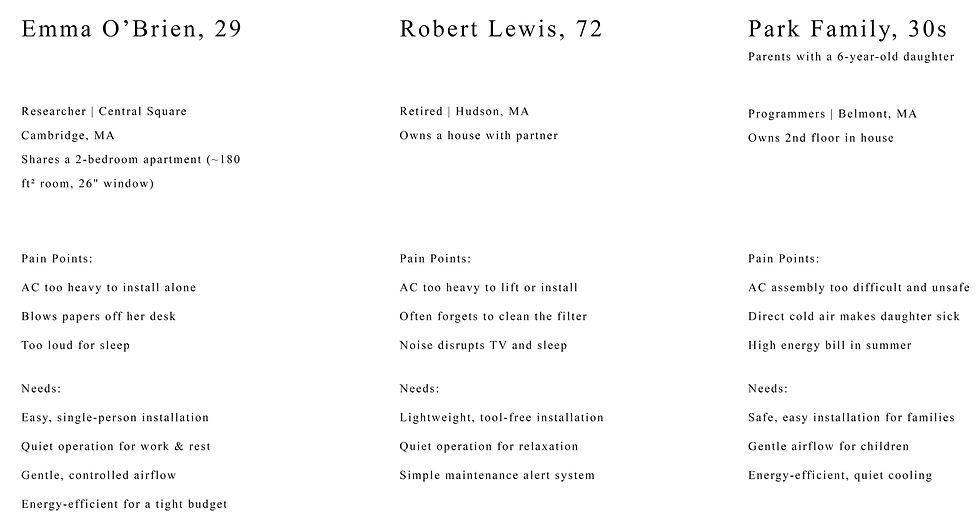
Heavyweight in Common
Emma
Robert
Park
Who Is This AC System For?
This research focuses on safer HVAC system architectures in institutional environments where window-mounted air conditioning units are often installed, maintained, or replaced by staff or residents under significant safety and operational constraints.
Primary Usable Environments
University & College Housing
Dormitories, graduate housing, faculty apartments
Assisted & Senior Living Facilities
Residences with higher ergonomic risks and reduced lifting capacity
Public & Subsidized Housing Programs
Supportive housing requiring durable and maintainable infrastructure

Why Places Care?
Institutional housing facilities frequently rely on window-mounted air conditioning systems due to infrastructure constraints. Installation and maintenance cycles often involve non-specialist staff and result in recurring risks of injury liability, labor strain, and operational cost. This research explores modular system architecture and interior-only installation design as potential interventions to reduce these risks at scale.
Applied Research Value
This project is not a commercial product proposal, but functions as an applied research exploration into HVAC system design that prioritizes safety, modularity, and serviceability in institutional contexts that will change people's lives.
LBs


Survey data and consumer reports indicate that over 60% of window AC users experience difficulty lifting their unit, commonly reporting back strain, shoulder pain, and fatigue.
30 LBs


Ideal Weight
Target Area
80 LBs
04
Probelm Addressing
5-gallon water
Average AC
70 LBs
fully packed suitcase
40 LBs
small dorm frige
50 LBs
wooden table
60 LBs
05
Root Cause

Why Window AC Units Are Heavy?
Heat exchangers
Compressor (primary mass)
Fan System
1. Traditional ACs are designed as sealed systems
2. Assembly is optimized for factory efficiency, not user handling
3. Structural rigidity is prioritized over modular access
Weight is not excessive because of performance requirements, but because the system is designed as a single, inseparable mass.
Design Strategy: Modular Weight Distribution

Traditional AC
Single Mass
1
2
3
Separate mass into functional modules
High-weight components should be divided into smaller, independently handled units rather than fused into a single structure.
Enable staged installation
Installation should allow components to be placed sequentially,
reducing peak lifting load and improving user control during setup and removal.
Maintain structural stability
At no point should the system rely on unstable balance or unsupported weight at the window edge.
Separate high-mass Components
Stage module placement
Secure to stable structural reference
06
Ideation
What if…
Your AC Could Install Like a Bookshelf?
Most household furniture can be installed by a single user through staged assembly and stable placement.
Window air conditioners, by contrast, require full-system lifting during installation.
This project explores how AC installation can adopt furniture-like assembly logic by reducing single-lift load and enabling modular placement.


Interior Constructional Design

AC Frame Design

Rear Exhaust layout
Complete screen coverage


These sketches explore early system logic and spatial configuration.
Interface and surface details are preliminary and do not represent final design decisions.


Compressor Unit
Condenser Coil Block
Aeris Modular System
Each module of Aeris functions independently; compressor, airflow, and sensor units operate through smart synchronization, simplifying maintenance while enabling precise adaptive cooling
07
Modular System
Axial-Centrifugal Motor Unit
Dual-Fan Turbine Assembly

Digital Thermal Sensor Port
Humidity Sensor


8 lBs
3 lBs
15 lBs
4 lBs
3 lBs
3 lBs
4 lBs
2 lBs
Average Window AC
65 lB
42 lB
total system weight
no single lift exceeds target handling range
Peak single-lift load reduced compared to conventional AC
Distributed Assembly Approach
AERIS is designed to be installed by a single user through a staged process
that prevents unstable lifting and distributes weight across multiple secure steps.
1. Install Structural Frame

The structural frame is installed independently to establish a secure reference before any high-mass components are introduced.
08
Modular System Architecture

Magnetic Connection

Sliding Mechanism
2. Insertion of Module

Structural frame interface
Load-bearing rail

3. Locking & Load Securing
Once seated, the module automatically locks to the structural frame, allowing hands-free installation.


Manual-locking rail interface
The locking interface transfers vertical load directly to the frame, eliminating sustained user support.
4. Modular Service & Component Replacement
AERIS is not a sealed appliance but a serviceable system.


Once installed, individual modules can be removed or replaced independently without tools, simplifying maintenance and extending product lifespan.
System Deployment

Clear System Boundaries
Core functional zones are spatially separated, allowing the system to evolve without redefining its architecture.
Unlike traditional window air conditioners that rely on external brackets and two-person installation, Aeris exists as part of the interior architecture.
The modular system enables installation, removal, and servicing to occur entirely from the interior side, reducing risk while maintaining a consistent spatial presence within the living environment.
Interior-only installation

Integrated into window architecture

Modularity for Adaptability
Modular components enable focused upgrades or replacements without affecting the entire system.
Separation of Concerns
Each component can be removed or updated without compromising system integrity.
Legible Interface Design

Like a car dashboard, Aeris stays calm and clear signals appears when something needs attention. Each icon lights up only for real issues
-
Leak Alert
-
Condensation Drain Alert
-
Compressor Issue
-
Clean Filter
-
Airflow System
-
Air Quality
Material Strategy

Alluminum Alloy

Tempered Glass

Low-Voc Coatings
100%
_gif.gif)
100%
100%
Why it Matters?

Most window ACs end up in landfills within 5 years due to corrosion, noise, or part failure.
Aeris reimagines the cycle: designed for part replacement, recycling, and reuse
09

System-Level Implications & Longevity
The design emphasizes system resilience through clear structure and replaceable components, enabling continued use without full replacement.
Longevity is treated as an outcome of organization, not optimization.
System Architecture
Internal System Zoning
Core functional systems are spatially separated, reducing interdependence and preventing single-point failure from cascading across the system.
Forgiving Architecture
The system is designed to tolerate partial failure, prioritizing continued operation and ease of intervention over total replacement.

Material choices support system clarity
10
11
Further Development


Optional remote access allows basic system monitoring and adjustment from a mobile device,
supporting flexibility without changing the primary interaction model.
System-Level Implications & Longevity
This project is framed as an applied research exploration into how HVAC system architecture can influence safety and long-term serviceability within institutional housing environments.
Rather than proposing a finalized product, the work uses a window-mounted air conditioning system as a case study to examine design decisions related to installation risk and maintenance access.
In institutional contexts such as university housing, assisted living facilities, and public housing, HVAC equipment is frequently installed or serviced by non-specialist personnel under safety and labor constraints. This research investigates modular system logic as a potential strategy for reducing physical handling risk while improving operational feasibility at scale.
The architectural principles explored in this project, modular weight distribution and interior-only service access, are intended to inform broader applied research in facilities management, building science, and safety-oriented design.
The project is positioned to support continued institutional investigation rather than immediate commercial deployment.
Concept-Level Ergonomic Exploration
A full-scale physical mock-up was constructed using a foam-core internal structure and plywood exterior shell to explore the feasibility of modular installation and handling workflows. The mock-up was not intended as a functional prototype, but as a physical reasoning tool to evaluate scale, weight perception, and installation sequencing.
Exploratory handling exercises suggest that separating the system into smaller modules significantly reduced perceived lifting difficulty compared to a single monolithic unit. Individual components were handled comfortably by a single person, supporting the assumption that staged installation could lower peak physical strain during setup and removal.
The assembly process was explored through a sequence of shorter handling steps rather than a single heavy lift. This physical walkthrough informed the proposed installation logic and highlighted potential advantages in reducing strain risk and improving controllability during interior-only installation. These observations are qualitative and intended to inform future ergonomic testing within institutional research or facilities management contexts.


Concept-level ergonomic test — users lifted full-scale modular mock-up (foam core + wood shell).
Perceived lift: “easy” (< 8 lb equivalent).
Assembly: 3–4 shorter steps instead of one heavy lift → strain risk ↓ 60 %, time ↓ 20 %


